
- This event has passed.
Alaska Entrepreneurship Community Stakeholders Session
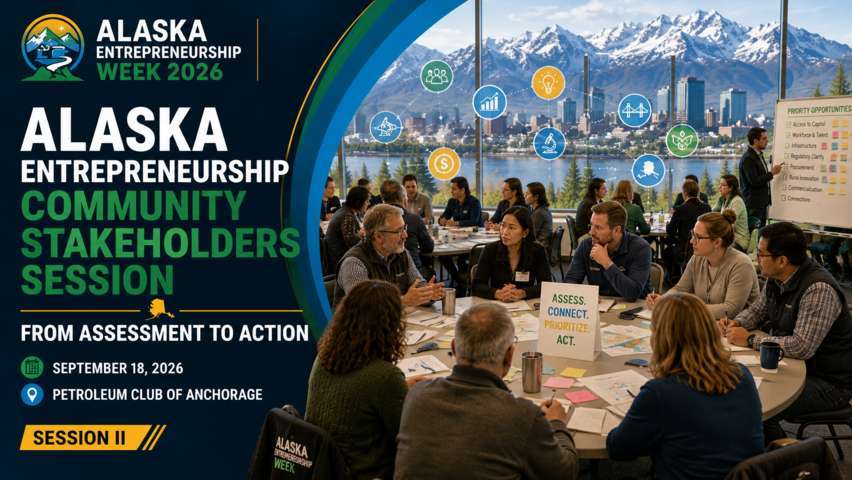
From Assessment to Action: Strengthening Alaska’s Entrepreneurial Ecosystem
Friday, September 18, 2026
Petroleum Club of Anchorage
3301 C Street, Anchorage, Alaska
Session I brings the public-leadership perspective into the conversation. Session II brings the whole entrepreneurial ecosystem to the table.
Throughout Alaska Entrepreneurship Week, entrepreneurs, business owners, investors, lenders, educators, researchers, economic development organizations, nonprofits, government representatives, advisors, and other members of Alaska’s entrepreneurial community will have exchanged ideas about what is working, what is changing, and where barriers remain.
Earlier on Friday, Session I adds another important perspective. Current elected officials and candidates discuss entrepreneurship and small business from the public-policy side of the ecosystem: what government can do, what it cannot do, what has already been attempted, what institutional or policy constraints exist, and what approaches they believe could strengthen Alaska’s entrepreneurial environment.
Session II brings those perspectives together. This facilitated working session combines what was heard during Session I with the experience accumulated by Alaska’s entrepreneurial community throughout the week, throughout the year, and through the direct experience of the people building, funding, supporting, regulating, researching, educating, and advising Alaska businesses.
The objective is to develop a more complete picture of where Alaska’s entrepreneurial ecosystem stands today and determine what should happen next.
Three Questions
Where are we now?
What is actually working? Where are entrepreneurs and small businesses struggling? Where are resources reaching businesses effectively, and where are they not? Where are organizations collaborating successfully? Where are gaps, fragmentation, unnecessary complexity, or duplication creating problems?
Where should we be?
What should a stronger entrepreneurial ecosystem in Alaska actually look like? What capabilities should exist? What should entrepreneurs be able to access more easily? What existing programs, relationships, policies, organizations, or resources should be reinforced? What is missing?
How do we get there?
Which problems can realistically be addressed? What should be improved, reinforced, connected, built, simplified, or reconsidered? And, most importantly: who is willing and able to take the next step?
This Is a Working Session
This is not another panel. It is not an organizational showcase. It is not a political debate. And it is not intended to produce another general conclusion that Alaska needs “more collaboration.”
Participants will be encouraged to identify specific problems, challenge assumptions, contribute direct experience, examine why existing approaches succeed or fail, and develop practical next steps where possible.
The objective is not artificial consensus. Different parts of Alaska’s entrepreneurial ecosystem see different pieces of the same system, and those differences are valuable. An entrepreneur may experience a problem one way. A lender may see a different constraint. An investor may identify a different risk. A government official may know that a proposed solution requires statutory authority. An agency representative may know that funding already exists but cannot legally be used in the proposed manner. A university or researcher may identify capabilities that businesses do not know exist. An economic development organization may see the same problem occurring repeatedly across dozens of businesses.
The purpose of putting these perspectives together is to understand the system, not simply the individual pieces.
What Will We Examine?
The discussion may include entrepreneurship and small-business formation and growth, access to capital and investment, early-stage and growth-stage financing gaps, innovation and technology commercialization, workforce development and talent retention, rural entrepreneurship and regional access to resources, infrastructure and connectivity, government procurement and contracting, regulation and administrative barriers, research and university-industry collaboration, healthcare, energy, technology and emerging industries, entrepreneurial education and mentorship, business assistance and technical support, coordination among entrepreneurship-support organizations, resource visibility and accessibility, economic diversification, attracting and retaining entrepreneurs and businesses, the roles of state, federal, municipal, private-sector, university and nonprofit actors, and opportunities for stronger collaboration across the ecosystem.
Who Should Participate?
Session II is intended for people who actively participate in some part of Alaska’s entrepreneurial ecosystem. That includes entrepreneurs and small-business owners who experience the system directly, investors and lenders who understand the realities of capital deployment, risk, and business readiness, government officials and public-sector professionals who understand governmental authority, policy, programs, implementation, procurement, regulation, funding, and institutional constraints, economic development and entrepreneurship-support organizations that work directly with businesses and communities, universities, researchers, educators, and commercialization professionals, nonprofit and community organizations, and advisors, mentors, professional-service providers, and industry leaders.
Participation Is Based on Stakeholder Role
The afternoon session is not a candidate forum. Participation is based on the experience, expertise, or stakeholder role a participant brings to Alaska’s entrepreneurial ecosystem.
Individuals who are also candidates for elected office may participate when they independently hold a relevant role within Alaska’s entrepreneurial ecosystem. Candidate status is not a basis for participation in Session II.
Campaign advocacy, electoral appeals, political fundraising, requests for political support, comparisons between candidates, or statements intended to promote or oppose a candidate are outside the scope of this session. Policy disagreement is welcome. Political campaigning is not.
Rules of Engagement
Problems before promotion. This is not an opportunity to deliver an organizational sales pitch. Programs and organizations should be discussed when they are relevant to understanding a problem, resource, solution, gap, or opportunity.
Experience before generalization. Specific examples, evidence, observed patterns, and direct experience are more useful than broad assumptions.
Understand before solving. Some apparent problems are symptoms of something else. Before proposing another program, funding source, organization, or initiative, the session will seek to understand what is creating the underlying problem.
Strengthen what already works. Not every solution requires something new. Where things are working, the question becomes how they can be reinforced, expanded, connected, or made easier to access.
Identify duplication and gaps. Alaska may simultaneously have multiple resources addressing one need while another need remains largely unserved. The session should make both visible.
Policy disagreement is welcome. Substantive disagreement can improve the analysis. The objective is a better understanding of the available choices, constraints, and consequences.
Discussion should lead somewhere. Where practical, significant issues should conclude with something more specific than “we should work together.”
Session Schedule
3:00 PM to 3:15 PM. Welcome, Objectives, and Ground Rules. Framing of the session, how Session I input will be used, and how the working discussion will run.
3:15 PM to 4:30 PM. Where Are We Now. Facilitated assessment of current ecosystem conditions, what is working, and where entrepreneurs and small businesses are struggling.
4:30 PM to 4:45 PM. Break.
4:45 PM to 6:00 PM. Where Should We Be. What a stronger Alaska entrepreneurial ecosystem should look like, which capabilities should exist, and what is missing.
6:00 PM to 7:00 PM. How Do We Get There. Priorities, practical next steps, what can be started now, what requires longer-term work, and who is positioned to help.
7:00 PM to 8:30 PM. Dinner and Continued Conversation. The formal working session transitions into dinner and networking, providing additional time to continue conversations, develop connections, and explore potential collaborations identified during the afternoon.
8:30 PM to 8:45 PM. Closing. Commitments, synthesis, and what happens next.
8:45 PM to 10:00 PM. Optional Networking. The venue remains open until 10:00 PM.
What Should Come Out of the Session?
Success does not require solving every challenge facing entrepreneurship in Alaska in one afternoon. It requires leaving with a better shared understanding than existed when the session began: what is working and should be reinforced, what is not working and why, where entrepreneurs are falling through the cracks, where resources exist but are difficult to discover or access, where organizations or programs are duplicating effort, where meaningful gaps remain, which barriers are structural and which are operational, which opportunities could be pursued relatively quickly, which challenges require longer-term work, and where stronger connections between stakeholders could produce meaningful results.
And wherever possible: who should do what next.
Registration
In-person participation is limited. Advance registration is required. Only 40 community registrations are available for the in-person session.
Session II and Dinner, $50 per person, includes participation in the Community Stakeholders Session, dinner, and networking.
Full Friday Program, $75 per person, includes the Session I Candidate and Public Leadership Forum, buffet lunch, the Session II Community Stakeholders Session, dinner, and networking throughout the day. To register for the full day, add both the Session I and Session II registrations to your cart and the $25 Full Friday saving is applied automatically at checkout.
Registration deadline: Monday, September 7, 2026, or before available community registrations are filled, whichever occurs first.
Parts of the program may also be accessible remotely through Google Meet. A free virtual registration is available below.
All registrations are final. No refunds are offered.
Attend virtually for FREE:
- Videoconference:
https://us06web.zoom.us/meeting/register/g7GGD0wRQsiE6q0BdZAUQA
Sponsor-Supported Tickets
Thanks to AKEW sponsors, a limited number of complimentary registrations are available for members of Alaska’s entrepreneurial community for whom registration cost would otherwise create a barrier. Sponsor-supported registration may be requested for Session I, Session II, or the full Friday program. An application is required. Availability is limited, and submitting an application does not guarantee a ticket.
Apply for a sponsor-supported registration
The application is deliberately demanding and takes most people twenty to thirty minutes to complete. It cannot be saved and resumed. Organizers review each application individually and may request more information before deciding. Applying does not guarantee a registration.
Thank You to Our Sponsors
AKEW’s September 18 programming is made possible with support from organizations investing in Alaska’s entrepreneurial community.
Tech Wildcatters
AK Coffee Company
REFocus
Sponsorships Are Still Available
Organizations interested in supporting Alaska’s entrepreneurial community can still participate as sponsors. Sponsorship can also help expand access by providing sponsor-supported registrations for entrepreneurs and community members who otherwise may not be able to participate.
Become a sponsor. Email contact@akew.org
From Session I to Session II
The two sessions are designed to work together. Session I provides the public leadership perspective. Session II integrates it with the experience of the broader entrepreneurial community. The objective is not to treat government, entrepreneurs, investors, universities, nonprofits, and support organizations as separate conversations. They are different parts of the same entrepreneurial system.
About Alaska Entrepreneurship Week
Alaska Entrepreneurship Week is a statewide, volunteer-led initiative designed to spotlight, support, and strengthen entrepreneurship across Alaska. AKEW brings entrepreneurs, small-business owners, mentors, investors, educators, support organizations, government partners, and other members of Alaska’s entrepreneurial ecosystem together through events, conversations, shared promotion, and statewide coordination.
Encourage – Leverage – Connect.
Registration is not open. Join the waitlist.
Seats are limited to 40 community registrations per session. Join the waitlist and you will be contacted in the order you signed up, with a link to register and a deadline to use it. Being on the waitlist does not reserve a seat and does not commit you to anything.